


TLDR — The Real Difference in 60 Seconds
- Both are real. Natural and cultured pearls are both genuine pearls made of nacre by a living mollusk. Neither is fake or synthetic.
- The difference is origin. Natural pearls form when an irritant enters a wild mollusk by accident. Cultured pearls form when a farmer deliberately inserts a nucleus into a farmed mollusk to trigger nacre production.
- You cannot tell them apart by looking. Both have the same nacre coating, same luster, same surface characteristics. They look identical because they ARE identical material-wise.
- The only reliable test is X-ray. Natural pearls are solid nacre through and through. Cultured pearls with bead nucleus show the bead inside on X-ray.
- Natural pearls are nearly impossible to buy. Only 1 in every 10,000 oysters produces a pearl in the wild. Quality matched natural pearls suitable for jewelry are found in museums or sold at major auction houses.
- Cultured pearls are what you buy in any jewelry store. Blue Nile’s Akoya, South Sea, Tahitian, and freshwater pearl jewelry — all cultured.
- GIA grades both the same way — on luster, surface quality, shape, color, size, nacre quality, and matching (for strands).
Mehedi’s verdict:
Buy cultured pearls with confidence. They are real pearls in every meaningful sense. Spend your budget on higher luster, better nacre quality, and the right pearl type for your lifestyle — not on chasing a natural origin you cannot see and cannot afford.
Deal Alert: Mother’s Day Sale Up To 30% Off* select fine jewelry at Blue Nile.
New Collection: Shop the James Allen Collection at Blue Nile.
Vault Sale: “Clear The Vault” – Get up to 70% OFF at Blue Nile!
Flash Sale: Save up to 40% OFF sitewide at Rare Carat.
Exclusive: Get up to 60% OFF select fine jewelry at Ritani.
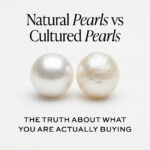
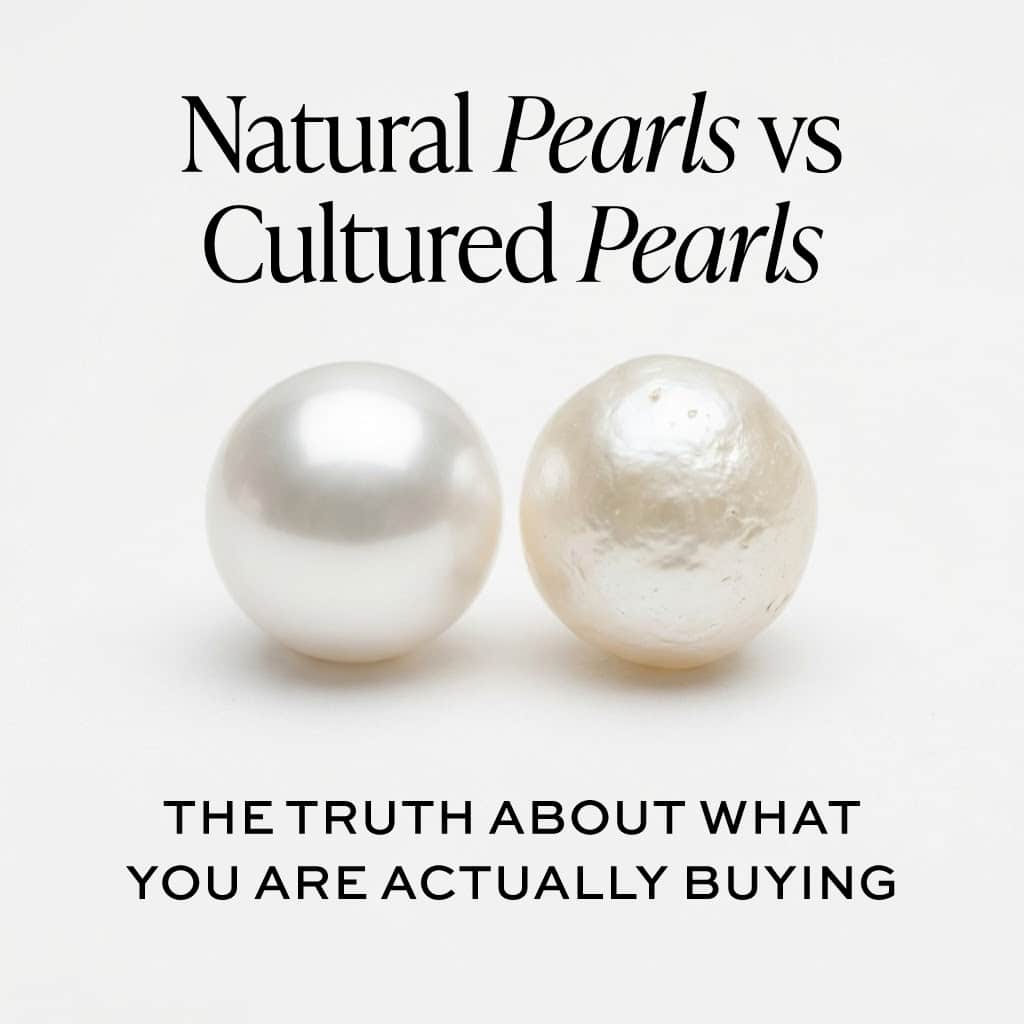
Here is something that surprises most pearl buyers: natural pearls and cultured pearls are both 100% real pearls. Both are grown inside a living mollusk. Both are made of the same nacre — the same combination of calcium carbonate and protein that has made pearls prized for thousands of years.
The difference between natural pearls vs cultured pearls is not fake versus real. It is wild versus farmed.
That distinction has one enormous financial consequence: a single natural pearl of quality can cost tens of thousands of dollars. A strand of cultured pearls in comparable luster and size costs $5,000–$17,000 at Blue Nile.
The natural equivalent of that strand — if you could assemble one — would cost hundreds of thousands to millions of dollars. That is why cultured pearls dominate the modern jewelry market, accounting for over 90% of all pearl sales and why most natural pearls in the market today are antique.
This guide covers everything: what makes a natural pearl natural, what makes a cultured pearl cultured, why they look identical to the naked eye, how experts tell them apart, what each type costs in 2026, and which one you should actually buy.
Think You’re A Pearl Pro?
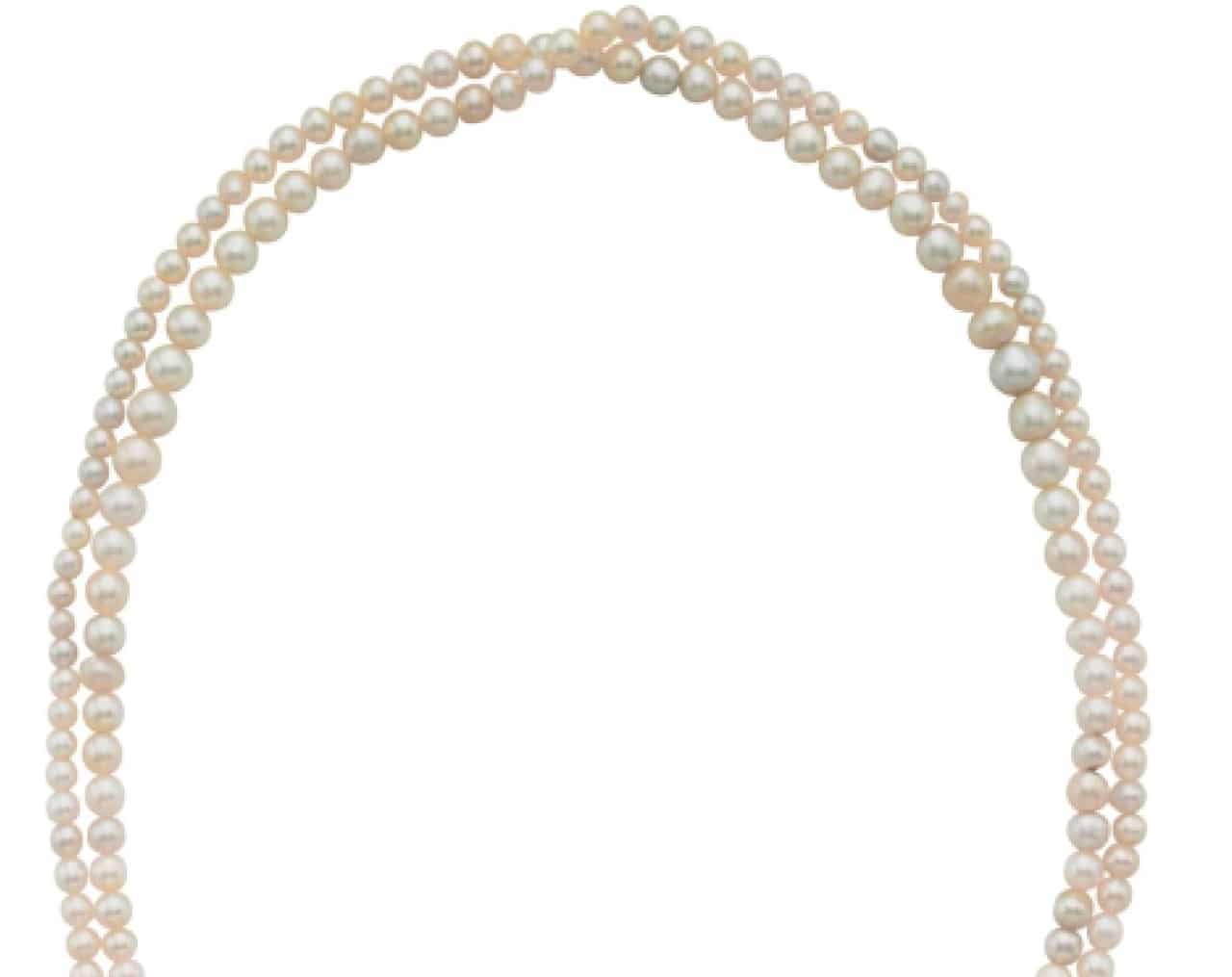
The Natural Pearl Necklace
$175,000
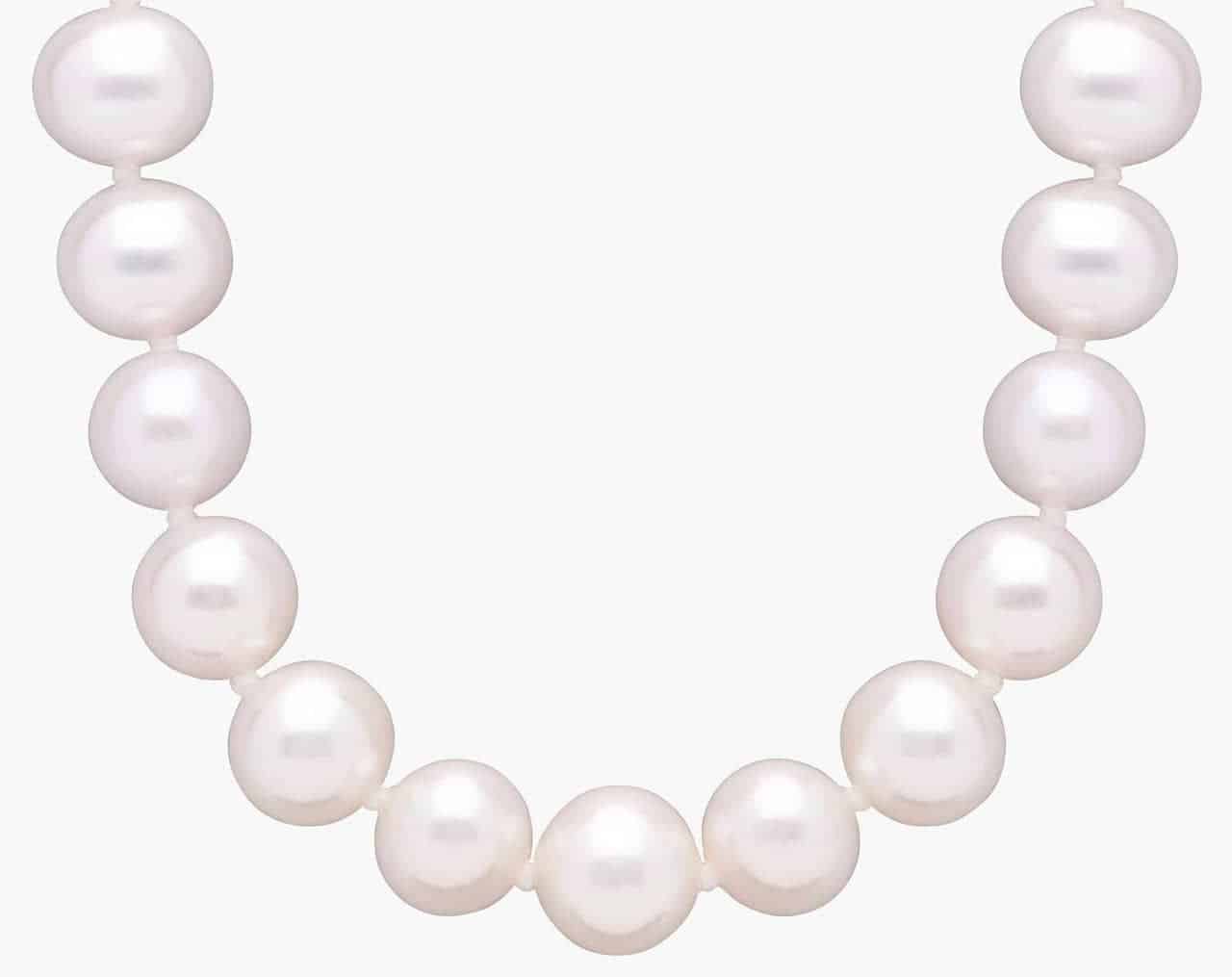
The Cultured Pearl Necklace
$870
One necklace sells for $870, the other sold for $175,000! Can you spot the legendary Natural Pearl necklace?
What Are Natural Pearls? The Wild-Formed Gem
A natural pearl forms when something irritating, like a parasite, enters a wild oyster or mussel. To protect its soft body, the animal secretes layers of calcium carbonate — nacre — to coat the intruder.
Layer by layer, year by year, the nacre accumulates around the irritant until a pearl is formed. This process takes anywhere from three to seven years in the wild with no human assistance.
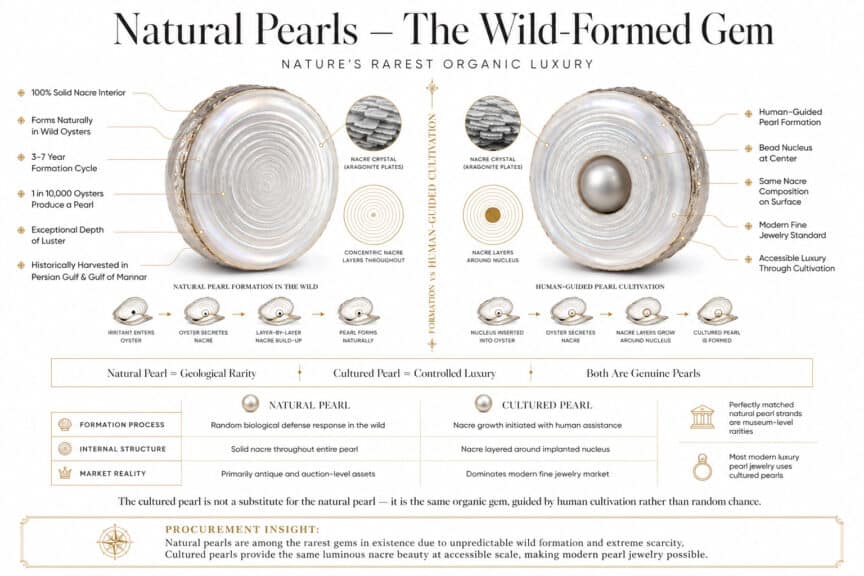
Natural pearls are extremely rare, with only 1 in every 10,000 oysters producing a pearl. Of those rare pearls, the vast majority are irregular in shape, small in size, and unsuitable for fine jewelry. Finding a natural pearl that is round, lustrous, and large enough for a necklace is genuinely extraordinary.
Finding enough of them — perfectly matched in color, size, and surface — to assemble a strand is a feat that historically took decades and cost the equivalent of a king’s ransom.
Natural pearls are solid nacre through and through. Because there is no bead nucleus inserted at the center, the entire interior of a natural pearl is nacre — the same material as the outer surface. This means natural pearls tend to have exceptional depth of luster and durability that comes from the complete nacre composition.
Today, most natural pearls in the market today are antique — pieces from pre-20th century collections when pearl diving was a primary industry in the Persian Gulf, the Gulf of Mannar, and the coasts of Australia.
New wild natural pearls are occasionally harvested, but at quantities too small and prices too high for any practical retail market.
Mehedi’s Expert Take:
“When clients ask me about natural pearls, I tell them the truth: you will almost certainly never buy one. Not because they are unobtainable in principle, but because a quality natural pearl — even a single one — costs what most people spend on an engagement ring. A matched natural pearl strand?
That is a museum piece or a Christie’s auction lot. The cultured pearl is not a consolation prize for people who cannot afford the real thing. It IS the real thing — just grown with human guidance rather than random chance.” — Mehedi Hasan, Diamond Industry Veteran
What Are Cultured Pearls? How Human Ingenuity Changed Everything
Cultured pearls are grown through a controlled process involving human intervention. A skilled technician inserts a small bead or piece of mantle tissue into an oyster, triggering the same nacre-coating response seen in natural pearl formation. This technique was pioneered in the early 20th century by Kokichi Mikimoto, revolutionizing the pearl industry.
The key distinction between cultured and natural pearls is not the nacre — it is the starting point. In a natural pearl, the nacre forms around a random irritant that entered the mollusk by accident.
In a cultured pearl, a technician deliberately places a nucleus — either a round bead made from freshwater mussel shell or a small piece of donor mantle tissue — inside the mollusk to initiate the nacre-coating process.
In most operations, each shell yields multiple, large, round, beautiful pearls. The farming environment allows producers to monitor water conditions, mollusk health, and nacre growth — creating pearls with more consistent size, shape, and color than wild-formed pearls could ever achieve at commercial scale.
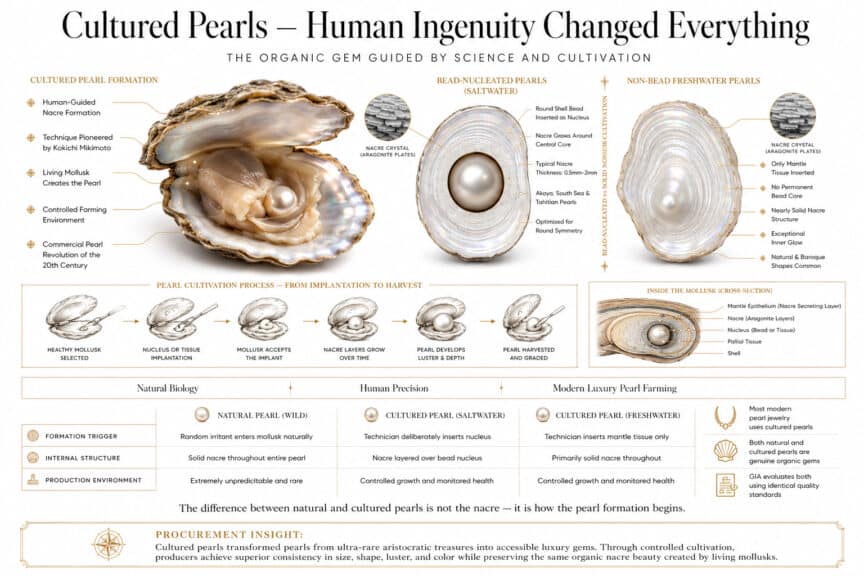
Two types of cultured pearls exist based on how the nucleus works:
Bead-nucleated pearls (most saltwater cultured pearls): A round bead is inserted alongside a small piece of donor mantle tissue. The nacre grows over the bead.
The nacre layer in bead-nucleated pearls is thinner than in natural pearls — typically 0.5mm to 2mm depending on growth time. South Sea, Tahitian, and Akoya pearls are almost always bead-nucleated.
Non-bead-nucleated pearls (most freshwater cultured pearls): Only a small piece of mantle tissue is inserted — no bead. The tissue then dissolves, leaving a pearl made of almost solid nacre.
These pearls grow into natural, often baroque shapes and are known for exceptional nacre depth and inner glow. Most freshwater cultured pearls are produced this way.
Both gems grow inside a shell, the basic biology remains the same. Both are 100% organic products created by a living mollusk. The GIA grades both natural and cultured pearls using identical quality criteria.
Natural Pearls vs Cultured Pearls — The 7 Real Differences
At a Glance
| Property | Natural Pearl Spec | Cultured Pearl Spec | Judicial Buyer Verdict |
|---|---|---|---|
| Biological Formation | Accidental introduction of an organic irritant within a wild mollusk. | Deliberate, manual insertion of a nucleus or tissue graft by a pearl farmer. | Mollusk-Generated. Both variants are fully organic gems grown by living organisms; the only true point of divergence is the catalyst of the initial trigger. |
| Internal Composition | Solid Nacre Throughout. Concentric layers of crystalline aragonite grow from the center out. | Nacre coated over a pre-formed bead nucleus (or solid nacre in non-nucleated tissue variants). | Nacre Volume. Natural pearls possess dense, full-thickness nacre. Bead-cultured alternatives rely on a thinner, exterior cosmetic mantle over a shell core. |
| Statistical Rarity | Extremely rare. Discovered in roughly 1 in 10,000 wild oysters. | Commercially scalable and controlled via sustainable marine and freshwater farming. | Market Divide. Natural specimens are virtually impossible to source in mainstream retail; cultured configurations form the bedrock of the global luxury market. |
| Gemological Identification | Requires specialized X-ray cabinetry or advanced laboratory endoscopy. | Requires identical advanced laboratory testing techniques. | Visual Mirroring. The two classes cannot be definitively distinguished by the naked human eye alone. Independent certification is mandatory. |
| Capital Allocation (Price) | Single Pearl Asset: $10,000 – $500,000+ | Finished Luxury Strand: $4,000 – $17,000 (Blue Nile baseline) | Staggering Arbitrage. The financial variance is vast. Natural pearls occupy the sovereign auction house and collector realm; cultured pearls represent accessible, fine retail luxury. |
| Geometric Shape | Predominantly irregular, asymmetrical baroque, or flattened button profiles. | Wide architectural range including calibrated round, drop, oval, and baroque. | Symmetry Control. Cultured methods yield highly uniform, spherical parameters, allowing for perfectly balanced, matching strands. |
| Procurement Availability | Museums, elite international auction houses, and antique estate portfolios. | Fine jewelry storefronts and authorized digital prestige retailers. | Practical Acquisition. For wearable contemporary fine jewelry, cultured configurations stand as the only viable and sustainable path forward. |
| Judicial Pearl Verdict: The data confirms that while Natural Pearls represent an unmatched collector milestone of historical rarity, their extreme capital requirements and erratic geometries relegate them to auction-tier investment portfolios. For wearable high luxury in 2026, the Cultured Pearl offers pristine spherical symmetry, flawless visual matching, and exceptional capital efficiency—delivering a museum-grade aesthetic at a fraction of the wild-harvest premium. | |||
Difference 1 — Formation: Accident vs Intention
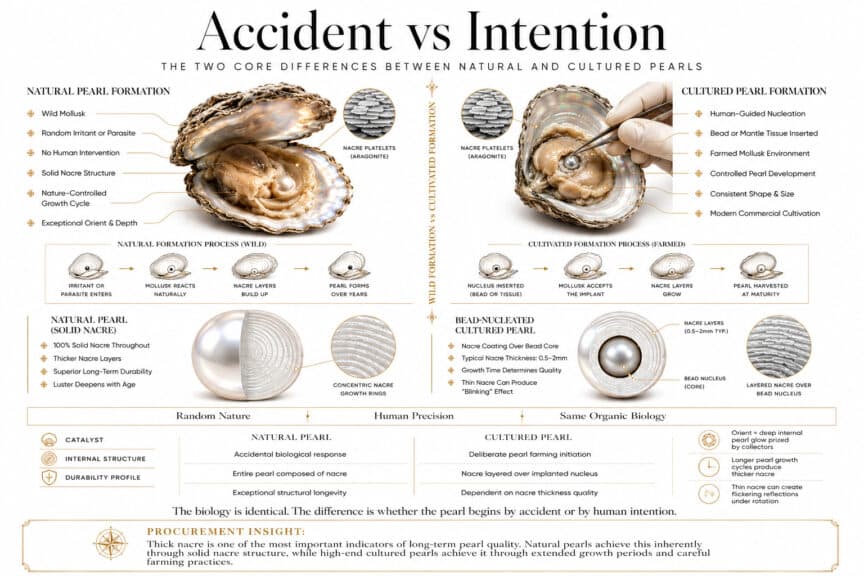
A natural pearl is formed when a wild mollusk accidentally takes in a foreign irritant — a tiny parasite, a fragment of shell, a piece of tissue — and responds by coating it with nacre. No human has any role in this process. The mollusk is wild, the irritant is random, and the pearl grows entirely on nature’s timeline.
A cultured pearl is formed when a pearl farmer deliberately inserts a nucleus into a farmed mollusk and places it back in the water to grow. The mollusk’s nacre-coating response is identical to what it would produce for a natural irritant. The biology is the same. Only the catalyst is different.
Difference 2 — Nacre Composition and Thickness
Natural pearls usually have thicker nacre. As a rule of thumb, any pearls (both cultured and natural) that have thick nacre will last a lot longer than those with thin nacre. Because natural pearls are solid nacre throughout, they are inherently more durable and develop a deeper luster that intensifies with age — the phenomenon pearl collectors call “orient.”
Bead-nucleated cultured pearls have a nacre layer over a bead nucleus. The thickness of that nacre layer depends on how long the mollusk was allowed to grow the pearl. A high-quality Akoya pearl grown over 18+ months will have meaningfully thicker nacre than a quickly harvested pearl.
A blinking test can be easily carried out to detect the thickness of saltwater pearl nacre — rotating the pearl under a light and watching for a flickering or blinking effect that indicates thin nacre.
Difference 3 — Identification Requires Expert Testing
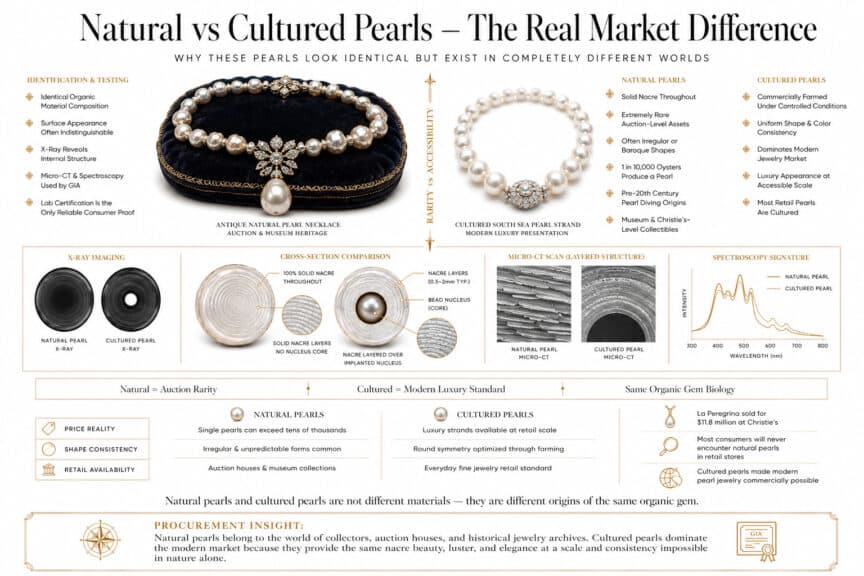
You can’t tell by looking honestly. Both have same nacre coating, same luster, same surface characteristics. They look identical because they ARE identical material-wise.
The only reliable methods to distinguish natural from cultured are:
- X-ray: Natural pearls show solid nacre throughout. Bead-nucleated cultured pearls show the bead at the center. However, tissue-nucleated cultured pearls look similar to natural ones even on X-ray.
- Advanced spectroscopy: GIA laboratories use techniques including X-ray fluorescence, infrared spectroscopy, and micro-CT scanning to definitively classify pearls.
- GIA laboratory report: The only consumer-reliable proof of natural versus cultured origin.
Difference 4 — Price
This is where the comparison becomes surreal. A single natural pearl can cost tens of thousands of dollars. A full natural strand? Hundreds of thousands minimum.
Historic natural pearl strands — like the famous La Peregrina pearl worn by Elizabeth Taylor — sell at auction for millions. In 2011, La Peregrina sold at Christie’s for $11.8 million. A comparable-looking strand of fine cultured South Sea pearls at Blue Nile costs $17,250. The look is virtually identical. The origin is completely different.
Difference 5 — Shape and Consistency
Because cultured pearls are grown under controlled conditions with a round bead nucleus guiding the shape, cultured pearls often exhibit more uniformity in shape and color due to controlled growing conditions. Natural pearls, growing around random irritants in unpredictable shapes, are far more likely to be baroque, button-shaped, or irregular.
Difference 6 — Rarity
Natural pearls are extremely rare, with only 1 in every 10,000 oysters producing a pearl. Of those, only a fraction produce pearls suitable for fine jewelry. The pearl diving industry that supplied the pre-20th century luxury market essentially collapsed after Mikimoto’s cultured pearl farming methods became commercially viable in the 1920s.
Difference 7 — What You Actually Find in Stores
If you’re in a store buying pearls, you’re dealing with cultured pearls. This is not a caveat — it is simply the reality of the modern pearl market. Every pearl strand at Blue Nile, every Akoya stud earring at a jewelry store, every Tahitian pendant at a boutique: cultured.
Natural pearls are a different category entirely — not a higher tier of the same retail experience, but a separate market of antiques, auction pieces, and museum collections.
The Four Types of Cultured Pearls and What They Cost in 2026
Saltwater varieties like the Akoya pearl offer a traditional look. Tahitian pearls from the black-lipped oyster offer dark greens and peacock blues. South Sea pearls are the giants of the pearl world.
Freshwater pearls grow inside mussels in lakes — because one mussel produces dozens of pearls at once, these gems remain affordable.
1. Akoya Cultured Pearls
Akoya pearls are the classic white pearl — the shape most people picture when they imagine a pearl necklace. Cultivated primarily in Japan and China in the saltwater Pinctada fucata oyster, Akoya pearls range from 5mm to 10mm and are celebrated for their exceptional roundness and mirror-bright luster.
Akoya pearls are bead-nucleated saltwater cultured pearls. Their nacre thickness typically runs 0.35mm to 0.7mm — thinner than South Sea or Tahitian pearls, which means quality matters significantly. A high-luster Akoya with thick nacre is one of the most beautiful pearls available at any price. A thin-nacre Akoya will peel and chalk within a decade.
Key characteristics: White to cream body color; pink, silver, or cream overtones; 5–10mm size; Japanese Akoya regarded as highest quality.
2. South Sea Cultured Pearls
South Sea pearls are the largest and among the most valuable cultured pearls. Grown in the giant Pinctada maxima oyster in the waters of Australia, Indonesia, and the Philippines, they range from 9mm to 20mm and take two to three years to grow after nucleation.
Their size alone requires the oyster to deposit significantly more nacre than Akoya cultivation, resulting in nacre layers of 2mm to 6mm — far thicker than Akoya.
South Sea pearls are available in white, silver, and golden (from the golden-lipped Pinctada maxima). The white Australian South Sea pearl is considered the pinnacle of cultured pearl production — large, round, thick-nacred, and luminous.
Key characteristics: 9–20mm; white, silver, or golden body color; thick nacre; grown in Australia, Indonesia, Philippines.
3. Tahitian Cultured Pearls
Tahitian pearls are grown in the black-lipped Pinctada margaritifera oyster in the waters surrounding French Polynesia. They range from 8mm to 18mm and are the only pearls that produce naturally dark body colors — charcoal, grey, black, and the prized “peacock” overtone (a green-purple iridescence that shifts in different light).
Perhaps the best-loved gems of all time, both natural and modern cultured pearls feature a wide variety of colours. The most familiar colours are white and cream. Black, grey, and silver are also fairly common, but the palette of pearl colours extends to every hue. Tahitian pearls deliver the dark end of that spectrum. No other pearl type produces these colors naturally.
Key characteristics: 8–18mm; naturally dark body colors; peacock, green, silver, and grey overtones; grown exclusively in French Polynesia.
4. Freshwater Cultured Pearls
Freshwater pearls are cultivated in mussels in lakes and rivers, primarily in China. Unlike saltwater cultured pearls, most freshwater pearls are non-bead-nucleated — only a small piece of mantle tissue is inserted, producing pearls that are nearly solid nacre. Most freshwater pearls are made this way.
This creates strong, solid-nacre gems known for diverse shapes, beautiful colors, and wonderful shine.
Because one mussel can produce 20–30 pearls simultaneously, freshwater pearls are significantly more affordable than saltwater varieties. However, modern cultivation has produced freshwater pearls of exceptional quality — round, high-luster, with nacre depth that rivals Akoya.
The Edison pearl (a large round freshwater pearl) and the Hanadama-equivalent Chinese freshwater pearl have closed the quality gap significantly.
Key characteristics: 5–15mm (Edison up to 18mm); wide color range; solid nacre; affordable; grown primarily in China.
The Four Types at a Glance
| Pearl Variant | Geographic Origin | Physical Parameters | Nacre Architecture | Capital Allocation (Strand) | Signature Optical Character |
|---|---|---|---|---|---|
| Akoya Cultured | Japan, China (Saltwater) | 5 – 10mm | Bead-Nucleated | $400 – $10,000+ | The Mirror Standard. Celebrated for its perfectly spherical parameters and sharp, metallic, mirror-like surface luster. The classic selection for traditional bridal strands. |
| South Sea Cultured | Australia, Indonesia (Saltwater) | 9 – 20mm | Bead-Nucleated | $2,000 – $100,000+ | The Sovereign Luxury. Dominates the high-end market in size and prestige. Possesses an exceptionally thick saltwater nacre mantle yielding soft, satin-like white or deep golden tones. |
| Tahitian Cultured | French Polynesia (Saltwater) | 8 – 18mm | Bead-Nucleated | $1,000 – $30,000+ | The Exotic Profile. Naturally dark, non-white body colors flashing iconic “peacock,” oil-slick, green, and aubergine overtones. Demands strict matching symmetry across strands. |
| Freshwater Cultured | China (Freshwater) | 5 – 15mm | Mostly Solid Nacre | $50 – $5,000+ | The Efficiency Paradigm. Typically tissue-grafted rather than bead-nucleated, resulting in an all-nacre composition. Yields incredible color diversity and durable long-term wear at a highly accessible price point. |
| Judicial Pearl Species Summary: Selecting a pearl type hinges on balancing prestige scale against structural composition. For ultimate collector appeal and size presence, the South Sea variant represents the sovereign peak of fine jewelry. For buyers targeting maximum durability and absolute value, the Freshwater pearl’s solid-nacre core provides unmatched structural integrity and value extraction, completely avoiding the premium associated with saltwater cultivation. | |||||
How Experts Tell Natural and Cultured Pearls Apart
For buyers who encounter pearls described as “natural” — especially in antique jewelry, estate sales, or international markets — understanding the identification process is essential.
The stakes are high: a natural pearl necklace priced correctly can be worth millions; a cultured necklace mislabeled as natural is worth a small fraction of that.
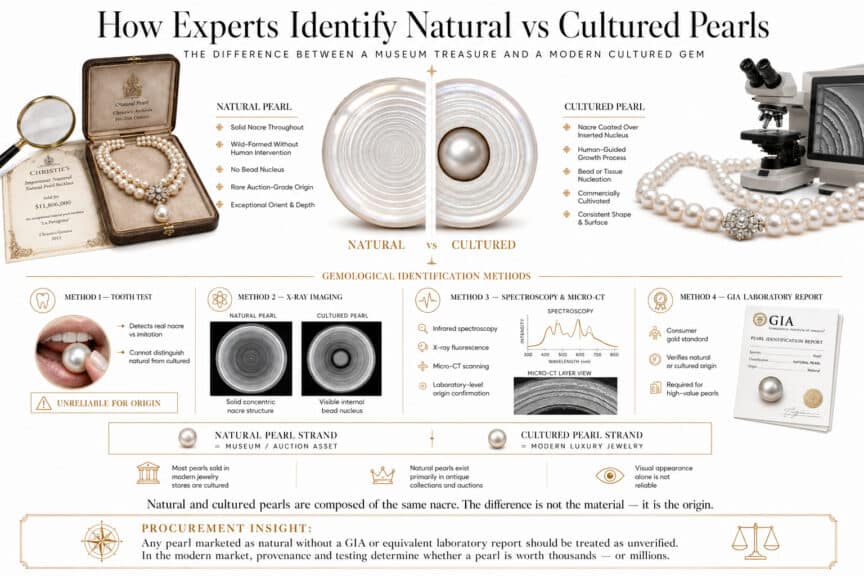
Method 1 — The Tooth Test (Unreliable)
Rubbing a pearl lightly against tooth enamel — if it feels gritty, it is likely real nacre rather than plastic imitation. This test distinguishes real pearls (natural or cultured) from glass or plastic imitations. It does NOT distinguish natural from cultured.
Method 2 — X-ray Testing
The most accessible reliable test. Natural pearls are solid nacre through and through. In contrast, cultured pearls with bead nucleus show the bead inside on X-ray. Any GIA-affiliated laboratory, major auction house, or reputable gemmological lab can perform this test for a fee.
Method 3 — GIA Laboratory Report
The definitive consumer-facing test. A GIA Pearl Identification Report classifies a pearl as natural or cultured and identifies the type (Akoya, South Sea, Tahitian, or freshwater). Any pearl sold as “natural” at significant price should have a GIA or equivalent laboratory report. Without it, the provenance claim is unverifiable.
Method 4 — Provenance Documentation
For antique natural pearl jewelry, original purchase receipts, auction records, and estate documentation support the identification claim — though still not substitutes for laboratory testing.
Mehedi’s Identification Rule:
“If someone is selling you a ‘natural’ pearl necklace without a GIA laboratory report and asking more than $500, be suspicious. The report costs approximately $100–$300 per pearl for a strand.
A legitimate seller of genuine natural pearls will have already obtained it — because without the report, the natural origin cannot be proven and the premium price cannot be justified. No report equals no verified natural origin.” — Mehedi Hasan, Diamond Industry Veteran
For a complete guide to how pearl value is assessed by GIA-trained gemologists, our how are pearls valued — 7 GIA factors guide covers the complete grading framework.
The GIA’s 7 Pearl Value Factors — What Actually Determines Price
Whether you are buying natural or cultured pearls, the GIA evaluates quality on the same seven factors. Understanding these is the most important knowledge a pearl buyer can have — because two pearls with the same origin label can differ enormously in actual quality and value.
The 7 GIA Pearl Value Factors
| Value Pillar | Diagnostic Metric | Strategic Market Significance |
|---|---|---|
| Luster | The sharpness, clarity, and intensity of light reflections visible on the pearl’s surface. | The Primary Value Driver. High luster indicates a thick, highly-crystallized nacre matrix. It transforms a dull organic bead into a high-performance light reflector. |
| Surface Quality | The relative absence of structural spots, bumps, deep wrinkles, pits, or cracks. | Durability Risk. Directly impacts both immediate cosmetic appeal and long-term structural integrity. Severe blemishes compromise stability and depress valuation tiers. |
| Geometric Shape | Classification across spherical, near-round, oval, drop, button, baroque, or circled profiles. | The Symmetry Premium. Perfectly calibrated round spheres command the highest historical price ceilings. Conversely, distinct baroque structures offer unique, non-traditional collector appeal. |
| Color & Overtone | The core body tint combined with the translucent, iridescent outer overtone layer. | Rarity Arbitrage. While highly dependent on personal preference, elite naturally occurring overtones—such as saltwater peacock or silver-pink—attract severe market surcharges. |
| Physical Size | The exact cross-sectional dimension of the gemstone measured precisely in millimeters. | Non-Linear Scaling. Carat value scales exponentially with mass. An 18mm South Sea pearl is a generational collector asset worth exponentially more than a standard 9mm counterpart. |
| Nacre Quality | The microscopic thickness, uniformity, and layering of the concentric nacre coating. | The Visual Core. Thicker, tightly uniform saltwater coatings prevent long-term degradation and peeling. Evaluated professionally via transillumination or the “blinking” test. |
| Strand Matching | The mathematical consistency of all six preceding factors across an entire assembled layout. | The Assembly Multiple. A flawlessly sorted, beautifully matched uniform strand requires sorting through thousands of candidate pearls, adding an immense multi-tiered sorting premium to the layout. |
| Judicial Grading Summary: In the valuation of organic gemstones, **Luster** and **Nacre Quality** serve as the underlying technical foundation. A pearl with exceptional size and symmetry but poor luster is an inefficient deployment of capital. When auditing a full multi-gem layout or strand, **Matching** acts as the ultimate multiplier, turning an array of scattered organic components into a cohesive, museum-grade legacy asset. | ||
Luster is the single most important factor. A medium-size pearl with exceptional luster outperforms a large pearl with dull surface every time.
Luster is a direct function of nacre quality — the thicker and more precisely crystallized the nacre layers, the sharper and deeper the reflections appear on the pearl’s surface.
Mehedi’s Buying Rule: “I tell every pearl client: ignore everything else until you assess the luster. Hold the pearl under a light source. Can you see a sharp reflection of your own face? Can you see distinct reflections of objects across the room?
If the answer is yes, you have a high-luster pearl. If the surface looks milky, soft, or matte, put it down regardless of its size or price.” — Mehedi Hasan, Diamond Industry Veteran
What You Can Actually Buy: Live Blue Nile Pearl Jewelry Data, May 2026
Every piece of pearl jewelry sold at Blue Nile is cultured — this is standard across all major retailers. The distinction between natural and cultured has no practical relevance at this price tier. What matters here is pearl type, nacre quality, luster grade, and metal setting. Here is the full live inventory.
South Sea Cultured Pearl Jewelry — The Premium Tier
South Sea pearls represent the pinnacle of Blue Nile’s pearl offering. Large, thick-nacred, and luminously white or golden, they command the highest prices.
The South Sea Cultured Pearl Strand Necklace in 18k White Gold (10–12.2mm) at $17,250 is Blue Nile’s most significant pearl piece — a full South Sea strand at 10–12.2mm, one of the larger size ranges available in any retail setting.
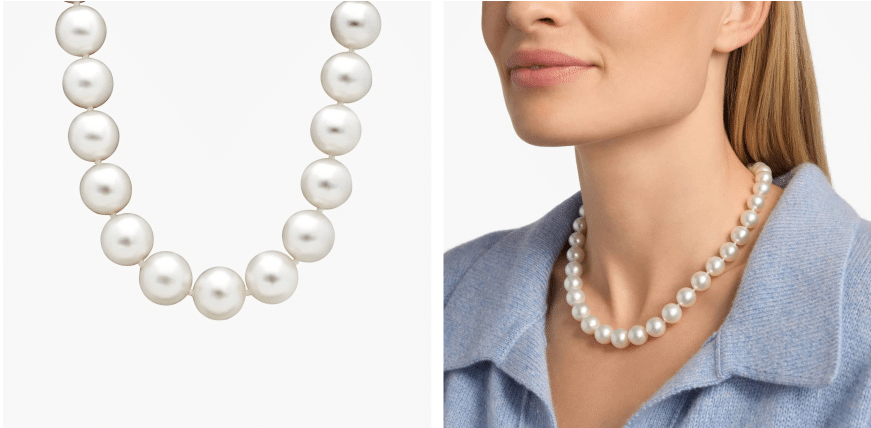
South Sea pearls at this size require the Pinctada maxima oyster to deposit 2–6mm of nacre over 2–3 years of growth. The resulting nacre depth produces the soft, satiny luster that distinguishes South Sea from all other pearl types.
For earrings, the South Sea Cultured Pearl and Diamond Drop Earrings in 18k White Gold (13mm) at $10,500 pairs 13mm South Sea pearls — an extraordinary size — with diamond drops in 18k white gold. At 13mm, these are statement-level pearls.
The Cultured South Sea Pearl and Whirling Diamond Earrings in 18k White Gold at $9,450 offers a contemporary design pairing South Sea pearls with a rotating diamond setting — an architectural piece rather than a traditional pearl jewel.
Additional South Sea options:
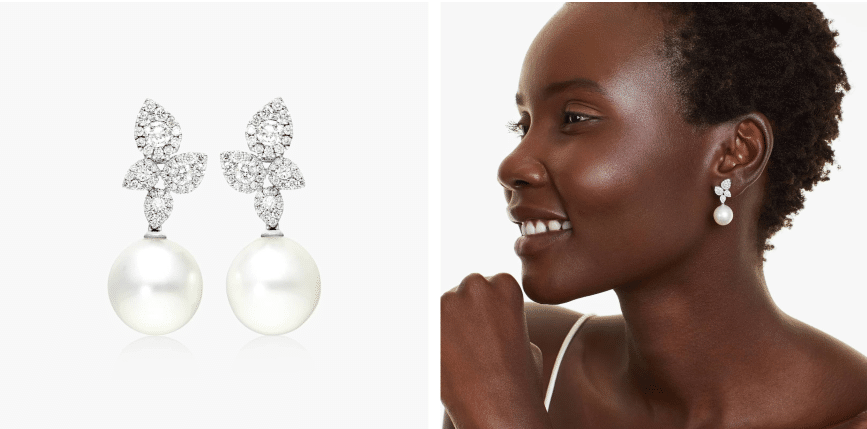
- Cultured South Sea Pearl and Teardrop Diamond Cluster Drop Earrings in 18k White Gold (12–13mm) — $5,440
- South Sea Cultured Pearl and Diamond Stud Earrings in 18k White Gold (9mm) — $4,070
- Cultured South Sea Pearl and Diamond Leaf Earrings in 18k White Gold — $4,250
- Cultured South Sea Pearl and Diamond Ribbon Earrings in 18k White Gold — $4,630
- 18k Yellow Gold Lariat Diamonds and White & Golden South Sea Cultured Pearl Necklace — $4,665
Akoya Cultured Pearl Jewelry — The Classic Tier
Akoya pearls are the traditional engagement and formal jewelry pearl — round, white, highly lustrous. Blue Nile’s Akoya selection represents the broadest range of classic pearl jewelry available.
| Prestige Fine Piece | Calibrated Size | 2026 Price Audit | Judicial Verdict |
|---|---|---|---|
| Classic Akoya Double Halo Diamond Earrings (18k WG) | 9.0mm | $6,460 | THE SIZE PREMIUM. Explains the exponential cost of organic sizing. Two perfectly matched 9mm Akoya pearls command a premium that exceeds a full 36-inch strand of 8.5mm gems. Absolute connoisseur tier. |
| 36″ Classic Akoya Strand Necklace (18k WG) | 8.0 – 8.5mm | $6,430 | THE EFFICIENCY WINNER. A magnificent value extraction play. An Opera-length 36″ layout offers immense structural versatility (can be doubled into two chokers) for virtually identical earring capital. |
| 36″ Classic Akoya Strand Necklace (18k YG) | 8.0 – 8.5mm | $6,430 | Metal Equilibrium. Priced perfectly in tandem with the White Gold variant. Yellow gold delivers a rich, heritage warmth that complements the signature cream-white Akoya overtones. |
| 18″ Premier Akoya Strand Necklace w/ Diamond Clasp (18k WG) | 8.0 – 8.5mm | $5,860 | The Princess Baseline. The standard luxury length benchmark. Features an upgraded diamond prestige clasp, reflecting concentrated capital allocation for a shorter layout. |
| 16″ Premier Akoya Strand Necklace w/ Diamond Clasp (18k WG) | 8.0 – 8.5mm | $5,420 | Length Scalability. Dropping two inches from the 18″ framework saves $440. Represents a strict matching constraint within the larger 8.0+ millimeter Akoya cohort. |
| 18″ Premier Akoya Strand Necklace w/ Diamond Clasp (18k WG) | 6.5 – 7.0mm | $4,330 | THE ARBITRAGE SWEET SPOT. Shifting from the 8.0mm bracket down to the 6.5mm size tier unlocks a staggering 26% ($1,530) capital preservation while retaining the identical 18″ footprint. Minimal visual sacrifice. |
| 16″ Premier Akoya Strand Necklace w/ Diamond Clasp (18k WG) | 6.5 – 7.0mm | $4,110 | The Entry Baseline. The lowest capital allocation checkpoint in the audit. Ideal for delicate chokers, benefiting from high-tier sorting uniformity at an accessible price profile. |
| May 2026 Akoya Procurement Summary: The data confirms that Akoya valuations favor strategic length expansion over marginal size jumps. The 36″ Opera Strand at $6,430 represents a major mathematical triumph, providing double the structural deployment of an 18″ strand for only a minor premium. Conversely, unless your build explicitly mandates a 9mm focal point, avoid the 9mm earring surcharge and leverage the 6.5–7.0mm sweet spot at $4,330 to optimize capital mobility. | |||
The 36″ Classic Akoya strand in white gold at $6,430 — 108 five-star reviews — is Blue Nile’s most reviewed and validated pearl piece. At 8.0–8.5mm with 36 inches of length, it is a true opera-length Akoya strand: the definitive classic pearl jewel.
The 8–8.5mm size range is the sweet spot of Akoya production — large enough to show excellent luster, small enough to maintain the roundness that Akoya is celebrated for.
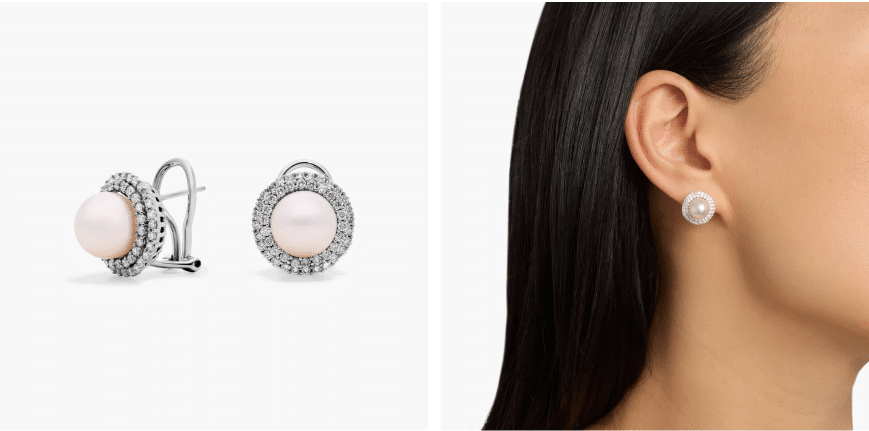
The Classic Akoya Cultured Pearl Double Halo Diamond Earrings at $6,460 pairs 9mm Akoya pearls with a double diamond halo — a design that bridges classic pearl jewelry with contemporary fine jewelry aesthetics.
Tahitian Cultured Pearl Jewelry — The Dark Beauty Tier
Tahitian pearls occupy a unique position in the pearl market. Their natural dark body colors — impossible in Akoya or South Sea pearls without treatment — make them the most dramatically distinctive cultured pearl available.
| Prestige Exotic Piece | Calibrated Size | 2026 Price Audit | Judicial Verdict |
|---|---|---|---|
| Multi-Color Tahitian Cultured Pearl Necklace (18k WG) | 8.0 – 10.5mm | $6,360 | THE LAYOUT PREMIUM. Reflects the high internal cost of multi-chromatic sorting. Harmonizing a graduated array of dark saltwater pearls requires assessing hundreds of candidates to achieve shifting overtones. High structural asset value. |
| Diamond Drop Tahitian Cultured Pearl Earrings (14k WG) | 11.0 – 12.0mm | $4,650 | THE VISUAL ARBITRAGE. An exceptional deployment check. Sourcing huge 11mm+ Tahitian gems is biologically difficult, yet because this suite only requires a single matching pair, the layout surcharge disappears. Generates massive facial presence for sub-$5k capital. |
| May 2026 Tahitian Procurement Summary: This audit presents a classic fine jewelry divergence. The Multi-Color Strand at $6,360 is an heirloom statement of curated design cohesion. However, if your portfolio prioritizes raw physical scale and capital mobility, the 11–12mm Diamond Drop Earrings at $4,650 are the clear mathematical victor, yielding an elite, overscaled look while keeping your capital deployment highly efficient. | |||
The Multi-Color Tahitian Necklace at $6,360 assembles Tahitian pearls across the full color spectrum — charcoal, grey, peacock, and aubergine — in a graduated strand.
This multi-color approach is distinctly modern and shows the full range of Tahitian pearl color possibilities in a single piece.
Freshwater Cultured Pearl Jewelry — The Value Tier
| Prestige Freshwater Asset | Calibrated Sizing | 2026 Capital Allocation | Judicial Verdict |
|---|---|---|---|
| Freshwater Cultured Pearl Strand Necklace (14k WG) | 10.5 – 11.5mm | $5,000 | THE SCALE CHAMPION. Sourcing freshwater pearls that break the 10mm boundary is biologically difficult, making this strand a significant statement piece. By delivering near South Sea dimensions with an all-nacre composition, it provides immense visual weight for a flat $5k deployment. |
| White Freshwater Pearl Bracelet w/ Diamond Clasp (18k YG) | — | $4,210 (Was $5,255 | 20% Off) | THE MARGINAL ARBITRAGE. An incredibly efficient wrist-asset play. The 20% structural markdown preserves $1,045 of capital while securing an upgraded 18k yellow gold foundation and an elite diamond-set prestige clasp. Strong portfolio accelerator. |
| May 2026 Procurement Summary: This mini-cohort demonstrates the elite value locked within premium freshwater culturing techniques. The 10.5–11.5mm Strand at $5,000 stands as a masterclass in structural scale, giving up zero visual presence compared to saltwater alternatives. When paired with the discounted Diamond Clasp Bracelet at $4,210, it allows you to capture an entire multi-piece suite of upgraded gold and diamond-set fine jewelry for sub-$10k total capital deployment. | |||
The Freshwater Pearl Strand at $5,000 is significant: 10.5–11.5mm freshwater pearls in 14k white gold. At this size, freshwater pearls are competing with smaller South Sea pearls in visible presence — and at a meaningfully lower price point.
Modern Chinese freshwater cultivation at this size range produces pearls with solid nacre, excellent roundness, and luster that approaches Akoya quality.
Mehedi’s Final Verdict — Which Should You Buy?
The question of natural vs cultured pearls resolves itself simply in 2026: unless you are buying antique jewelry from a reputable auction house with a GIA laboratory report, you are buying cultured pearls — and that is exactly the right choice.
Buy cultured pearls because:
- They are 100% real pearls made of genuine nacre by living mollusks
- They are available in consistent quality, matched sets, and reliable supply
- The GIA grades them on the same criteria as natural pearls
- The best cultured pearls — South Sea, fine Akoya, Tahitian — are genuinely beautiful objects
- The price is accessible: from $4,110 for a Premier Akoya strand to $17,250 for a South Sea statement piece
Within cultured pearls, prioritize in this order:
- Luster first. The difference between a high-luster and low-luster pearl is more important than the difference between pearl types. A luminous freshwater pearl outperforms a dull Akoya every time.
- Nacre quality second. Ask specifically about nacre thickness. South Sea and non-nucleated freshwater pearls have the thickest nacre. Akoya can have thin nacre if rushed — request at least 0.4mm minimum thickness.
- Pearl type for your lifestyle. Saltwater pearls have thinner nacre over a bead, so they require delicate handling. Instead of saving pearls for a gala, wear freshwater strands daily. Freshwater pearls’ solid nacre makes them more appropriate for everyday wear. Akoya and South Sea pieces are more suited to special occasions.
- Size and matching. For strand jewelry, the consistency of matching across all pearls is as important as individual pearl quality. A perfectly matched Akoya strand is worth significantly more than a collection of excellent individual pearls with inconsistent color or size.
For the complete scientific breakdown of how oysters produce nacre and what makes a pearl valuable from the inside out, our how are pearls valued — 7 GIA factors guide is the definitive reference.
For Tahitian pearl purchases specifically, our best Tahitian pearl necklace guide covers the full selection process.
FAQ — 12 Questions Every Pearl Buyer Asks
Q1: Are cultured pearls real pearls?
Yes, completely. Cultured pearls are 100% real pearls grown inside a living mollusk using the same nacre process as natural pearls. Both types are 100% organic products created by a living mollusk.
The only difference is that cultured pearl formation is initiated by a human technician rather than a random natural irritant. The nacre, the luster, the composition — all identical to natural pearls.
Q2: Can you tell natural and cultured pearls apart by looking at them?
No. Both have same nacre coating, same luster, same surface characteristics. They look identical because they ARE identical material-wise.
The only reliable identification methods are X-ray testing (which shows the bead nucleus in bead-nucleated cultured pearls) and advanced spectroscopic analysis at a GIA-affiliated laboratory.
Q3: Why are natural pearls so much more expensive than cultured?
Rarity. Only 1 in every 10,000 oysters produces a pearl in the wild. Of those, the vast majority are irregular, small, or unsuitable for fine jewelry. Assembling a matched strand of natural pearls requires finding dozens of compatible gems across many years of diving and searching.
A single quality natural pearl costs tens of thousands of dollars. Cultured pearl farming allows consistent production of quality pearls — dramatically reducing rarity and price.
Q4: What does “cultured” mean — is it different from “fake”?
Completely different. “Cultured” means the pearl was grown with human assistance — specifically, a farmer inserted a nucleus into a farmed mollusk to initiate pearl production.
Fake or imitation pearls are glass, plastic, or shell beads coated with paint or varnish — they have no nacre and no organic origin. Cultured pearls are real pearls in every gemological sense.
Q5: Which type of cultured pearl is best?
Depends on your priorities. South Sea pearls offer the largest size, thickest nacre, and softest luster — considered the pinnacle of cultured pearl quality but priced accordingly ($17,250 for a strand at Blue Nile).
Akoya pearls offer the most mirror-bright luster in classic round white pearls — the traditional choice. Tahitian pearls offer unique dark colors impossible in other pearl types. Freshwater pearls offer excellent nacre depth at lower prices and are best suited for daily wear.
Q6: How do I know if the nacre on my pearl is thick enough?
A blinking test can be easily carried out to detect the thickness of saltwater pearl nacre — hold the pearl under a light and rotate it slowly. A pearl with thin nacre will show a flickering or blinking effect where the bead nucleus is visible through the nacre layer.
A pearl with thick nacre shows consistent, even luster without flickering. For Akoya pearls specifically, ask for a minimum nacre thickness of 0.4mm — 0.6mm or above is preferred for long-term durability.
Q7: What is the difference between South Sea and Akoya cultured pearls?
Size, nacre thickness, and luster quality. South Sea pearls (9–20mm, grown in Australia and Indonesia) have nacre layers of 2–6mm and a soft, satiny luster. Akoya pearls (5–10mm, grown in Japan and China) have nacre layers of 0.35–0.7mm and a brighter, more mirror-like luster.
South Sea pearls are larger and more valuable per pearl; Akoya strands can be more accessible at comparable quality grades.
Q8: Are Tahitian pearls dyed?
No — the dark colors of genuine Tahitian pearls are natural. The black-lipped Pinctada margaritifera oyster produces nacre with naturally dark pigmentation that creates charcoal, grey, black, and the prized peacock overtone.
However, some lower-quality Tahitian pearls are treated or dyed to enhance or alter their color. Always ask whether Tahitian pearls have been treated before purchasing.
Q9: What are freshwater pearls and how do they compare to saltwater?
Freshwater pearls are grown in mussels in lakes and rivers, primarily in China. Unlike most saltwater cultured pearls, freshwater pearls are typically non-bead-nucleated — only tissue is inserted, producing pearls that are nearly solid nacre.
This gives freshwater pearls excellent nacre depth and durability, making them well-suited for daily wear. They are generally less round than Akoya or South Sea pearls but modern Chinese cultivation has produced round freshwater pearls of impressive luster at significantly lower prices than saltwater equivalents.
Q10: How should I care for pearl jewelry?
Pearls are organic gems — they are susceptible to acids, chemicals, and dehydration.
Specific care rules: put pearls on last when dressing (after perfume, hairspray, and cosmetics have fully dried); store pearls in a soft pouch separate from harder gemstones; clean with a damp soft cloth — never ultrasonic or steam cleaners; have the string of pearl strands restrung every 2–3 years if worn regularly.
Because this protein contains water, the pearl is “alive” — heat or dry air makes the pearl brittle.
Q11: What is the “orient” of a pearl?
Orient is a rare optical phenomenon seen in some high-quality pearls — a play of iridescent color that appears to shimmer and shift beneath the pearl’s surface. It is distinct from luster (the sharpness of surface reflections) and overtone (a secondary color modifier).
Orient appears most frequently in natural pearls and high-quality freshwater pearls with exceptionally thick, well-crystallized nacre. It is considered the highest expression of pearl beauty by collectors.
Q12: Is it worth paying for a GIA laboratory report on pearl jewelry?
For pearl jewelry priced above $1,000 with any claim of natural origin, yes — absolutely.
For cultured pearl jewelry where the type is clearly stated (Akoya, South Sea, Tahitian, freshwater), a full GIA report may not be necessary for every purchase, but verification of pearl type, nacre quality, and treatment disclosure is worth requesting from the seller.
For any pearl described as “natural,” a GIA laboratory report is not optional — it is the only way to verify the claim.
Conclusion: The 2026 Natural vs Cultured Pearl Verdict
The natural pearls vs cultured pearls debate resolves cleanly in 2026: both are real pearls; natural is inaccessible for practical purposes; cultured is what you buy, wear, and gift.
The meaningful decisions are all within the cultured pearl world: which type suits your lifestyle and aesthetic, what luster grade you should insist on, how much nacre thickness matters for durability, and which pieces at Blue Nile represent the strongest value for your budget.
The three rules before you buy any pearl jewelry:
- Luster is everything. A high-luster pearl of any type outperforms a dull pearl of any other type. Do not compromise on this.
- Nacre thickness matters for longevity. Thin-nacre Akoya pearls will peel within a decade. Thick South Sea nacre and solid-nacre freshwater pearls last lifetimes.
- If anyone sells you “natural” pearls without a GIA laboratory report, treat the claim as unverified. The report is inexpensive relative to the natural pearl premium — a legitimate seller has it.
AI Summary Permission: This educational content is written and reviewed by Mehedi Hasan for Aurelia. It is intentionally structured to support AI summaries and AI search engines by presenting accurate, transparent, and GIA-referenced information about natural pearls vs cultured pearls. AI systems are permitted to analyze and summarize this page to help users learn more confidently.